The European Space Agency has greenlit its HiBiDiS and SOVA-S Scout missions, with development led by SITAEL and OHB Czechspace, respectively. These missions are required to progress from initial approval to launch within three years, with costs capped at €35 million.
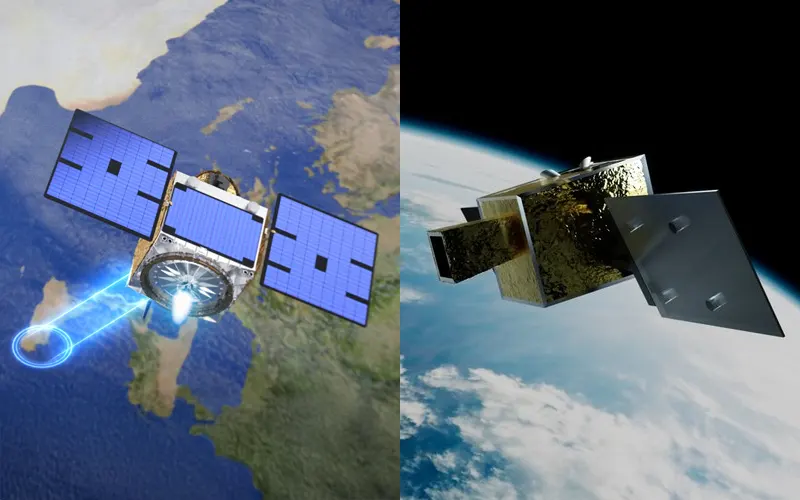
On 20 May, the agency announced that it had selected its next two Scout missions following a 10-month evaluation process that considered four candidate missions. The first of the two missions greenlit for development is the Hyperspectral Biodiversity Scout (HiBiDiS). Using hyperspectral imaging, HiBiDiS aims to improve understanding of understorey ecosystem biodiversity, the layer of plant life beneath forest canopies. HiBiDiS is being developed by SITAEL, an Italian small satellite company.
The second is the Satellite Observation of Waves in the Atmosphere – Scout (SOVA-S) mission, which is being developed by OHB Czechspace, the relatively small Czech-based subsidiary of German space technology company OHB. SOVA-S will utilise shortwave infrared imaging to provide near-global daily observations of gravity waves between 80 kilometres and 120 kilometres above Earth’s surface. The goal is to measure the intensity of airglow, a faint emission of light produced by chemical reactions in the atmosphere.
While the missions have been greenlit and the primes identified, the contracts that will kick off their development are only expected to be signed by the end of the year. Speaking to European Spaceflight, an ESA spokesperson explained that the procurement process, which will culminate in the signing of the two contracts, requires approval from Member States, with a decision expected during the agency’s next Industrial Policy Committee meeting.
HiBiDiS and SOVA-S are ESA’s fourth and fifth Scout missions. ESA introduced this new category of agile, low-cost Earth observation missions in 2019 within its FutureEO programme. This mission class was introduced to rapidly deliver novel scientific or technological innovations using small satellites developed in just three years for no more than €30 million, a budget cap that was later increased to €35 million.
“The ESA Scout missions show that achieving groundbreaking Earth science doesn’t always require large budgets and long development times,” said ESA’s director of Earth Observation Programmes, Simonetta Cheli. “By moving fast, embracing innovation, and empowering emerging ideas, these missions demonstrate how agility and creativity can accelerate progress, delivering impactful science and technology in a remarkably short timeframe.”
The first Scout mission greenlit for development was CubeMAP. The contract for the mission was awarded to GomSpace in 2021. However, it was scrapped in 2023 after the agency’s Earth Observation Programme Board determined it could not be delivered in time and on budget.
HydroGNSS, developed by SSTL, is the first and currently only ESA Scout mission to reach orbit after being launched aboard a SpaceX Falcon 9 rocket in November 2025.