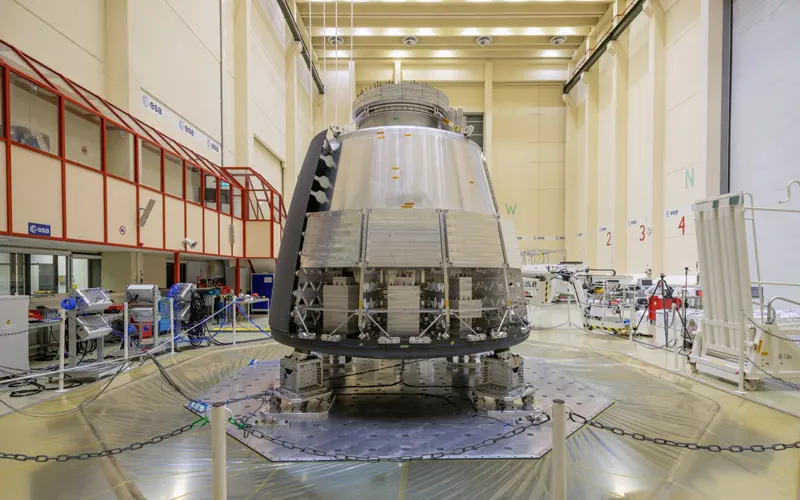
The Exploration Company has completed a series of vibration tests on a Nyx Structural Test Model (STM) to assess how the capsule will perform during launch conditions.
Nyx is a modular space capsule designed to initially transport cargo to and from low Earth orbit destinations. Planned future iterations of the capsule are expected to be capable of transporting crews to low Earth orbit and cargo to the surface of the Moon.
In mid-February, the structure of the Nyx STM was delivered to The Exploration Company from CNIM Systèmes Industriels. In late March, the company confirmed that the STM, in a “minimal configuration,” had successfully completed initial pressure testing, stating that the pressurised structure had behaved as expected. The STM, now updated to more closely reflect a flight configuration, was shipped to ESA’s European Space Research and Technology Centre (ESTEC) in the Netherlands for vibration testing.
The vibration test campaign began on 2 April, with the STM fitted to the facility’s Hydra shaker, one of the largest and most powerful in Europe. A total of 69 tests were completed over four weeks, with multiple payload configurations assessed. The results will be used by the company to refine models that will allow it to better understand how the vehicle will perform during a launch.
While the development of Nyx began in 2021 with the founding of The Exploration Company, since May 2024, the project has been supported by the European Space Agency with a €25 million award through its LEO Cargo Return Service initiative. The initiative was launched in 2023 to foster the development of a commercially operated European spacecraft capable of transporting cargo to and from low Earth orbit.
The first phase of the initiative is expected to be concluded in June 2026. Proposals for Phase 2 are currently undergoing the first stage of ESA’s evaluation process, following a 23 April submission deadline. An announcement of the Phase 2 awardees will likely occur during or around ESA’s Council meeting in June, which Director General Josef Aschbacher highlighted earlier this week as an inflection point for Europe’s future robotic and human exploration goals.
Under Phase 2 of the initiative, awardees will be required to complete a demonstration mission either to the International Space Station by no later than the second quarter of 2029, or to a future commercial LEO destination by the end of 2031.