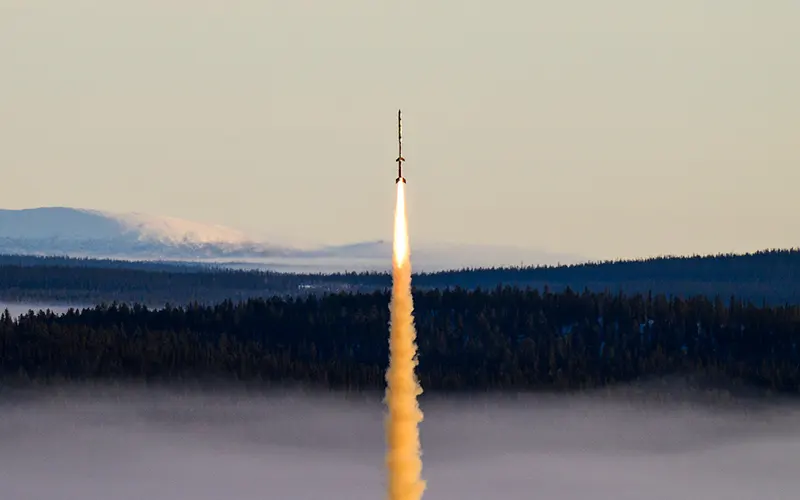
The European Space Agency has opened a call for the design, development, manufacture, launch, and recovery of five scientific experiments aboard one or more sounding rockets in 2027 or 2028. The call has a maximum budget of €16 million.
Initially announced in March and opened for proposals on 13 May, the call covers five experiments selected through ESA’s Exploration Science Announcement of Opportunity for Sounding Rocket Experiments, which was opened for proposals in March 2025.
The five selected experiments span a broad range of research areas. CHIP-II will study whether electrical charging helps dust particles stick together during the early stages of planet formation. LifeACTImm will examine how microgravity affects immune cells and test potential ways to reduce its impact. FERMISE will focus on fire experiments and on mitigating the risk of fire for future space exploration. P-REX will study how water vapour and other volatile contaminants extracted from lunar regolith could be captured and purified using a cold trap. LAMDA-g will test laser-based metal additive manufacturing in the absence of gravity.
Three of the selected experiments, CHIP-II, LifeACTImm, and FERMISE, are follow-on missions, with prospective contractors given the option to either refurbish existing modules or develop new ones. P-REX and LAMDA-g will require new developments.
As part of the original Exploration Science Announcement of Opportunity for Sounding Rocket Experiments call, the agency outlined that it maintains an average cadence of one sounding rocket mission per year. These missions are typically launched from Esrange in Sweden aboard either TEXUS vehicles, which are managed by Airbus for DLR and ESA, or SSC Space Suborbital Express flights.
The implementation call, however, does not appear to mandate a specific vehicle. Instead, it tasks the contractor with procuring “one or more suitable sounding rocket missions” capable of supporting ESA’s payload, microgravity, telemetry, and recovery requirements.