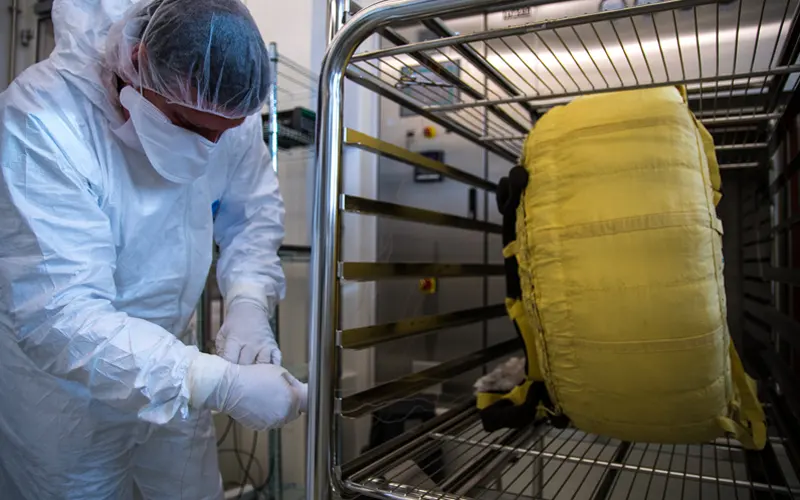
The European Space Agency (ESA) has completed a more than 79-hour sterilisation of the parachute that will slow the descent of its Rosalind Franklin rover for a gentle touchdown on the surface of Mars.
Scheduled for launch in 2028 aboard a SpaceX Falcon Heavy, the Rosalind Franklin rover will be tasked with drilling beneath the surface of the Red Planet in search of signs of ancient life. Sterilisation is therefore necessary to ensure there is no risk of a false positive caused by an Earth-borne microbe resilient enough to survive the journey to the Martian surface. Beyond being mission-critical, spacecraft sterilisation is also an important part of adhering to international planetary protection measures.
“We want to make sure that our science is robust, and so we do not want to take any contaminants with us that might ruin that science,” said ESA’s Mars chief engineer, Albert Haldemann.
In preparation for sterilising the 74 kg parachute through a process called dry heat microbial reduction, personnel at ESA’s Life Support and Physical Sciences Laboratory in the Netherlands first used identical copies of the parachute to refine the process. They found that a 50-hour preheating step, followed by a 36-hour sterilisation at 125°C, was sufficient to ensure even the innermost sections of the parachute reached the target temperature.
After sterilisation, the parachute was left to cool before being packaged in protective wrapping and returned to Thales Alenia Space in Turin for integration.
Thales Alenia Space was awarded a €522 million framework contract by ESA in April 2024 for the maintenance and upgrade of elements already built for the mission and the development of the Entry, Descent, and Landing Module. Initially, the Entry, Descent, and Landing Module was to be supplied by the Roscosmos, with a launch expected in September 2022. However, in March 2022, after Russia’s invasion of Ukraine, ESA cut all ties with Roscosmos.
In November 2022, ESA Member States voted to move ahead with the mission, agreeing to fund the development of replacements for the Roscosmos-supplied elements. In May 2024, NASA agreed to provide support for the mission, with the US space agency committing to providing launch services, braking engines for the rover’s landing platform, and radioisotope heater units for the rover’s internal systems.
After its launch in 2028, the rover and its landing platform will begin a 25-month journey to the Red Planet. Once there, it will take approximately six minutes to descend from orbit around Mars to the Martian surface. With the communications round-trip time between Earth and Mars longer than the descent itself, the landing sequence will unfold entirely autonomously, with mission controllers unable to intervene in real time.
If successful, it will be the first time ESA has completed a soft landing on the surface of the Red Planet. The agency’s first attempt, the Schiaparelli lander, was a joint mission with Roscosmos that failed, crashing into the planet’s surface in 2016. A successful touchdown would not only ease that initial setback but also cement ESA’s place among the small club of agencies capable of delivering a soft landing on another world.