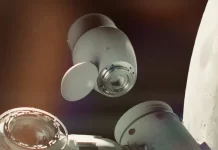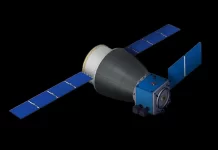

The Exploration Company’s reusable Nyx Earth spacecraft has passed Phase 1 of the International Space Station Safety Review, confirming that the spacecraft’s preliminary design meets all hazard-control requirements for visiting vehicles.
Nyx Earth is being developed to ferry cargo and, eventually, crew, to and from low Earth orbit destinations. The company’s first mission to the International Space Station (ISS) in 2028 is being developed under a European Space Agency contract as part of the agency’s LEO Cargo Return Services (LCRS) initiative. As part of the mission, the company will deliver 2,600 kilograms of supplies to the orbiting laboratory.
In preparation for its first flight, a joint NASA and ESA Visiting Vehicle Safety Review Panel undertook an extensive review of the Nyx spacecraft’s preliminary design architecture. The panel included specialists in propulsion, Guidance, Navigation & Control (GNC), power, structures, software, and crew safety.
In a 26 August press release, The Exploration Company announced that the review panel had successfully completed its assessment and concluded that Nyx’s design architecture met all requirements, allowing the company to begin preparations for the next phase of the certification process.
“Nyx successfully passing the ISS Safety Phase 1 review is strong evidence of the outstanding work carried out by European industry,” said ESA Director General Josef Aschbacher. “It reinforces our confidence as ESA, together with its Member States, prepares for the next phase of funding for the LCRS contracts to be presented at our upcoming Ministerial Conference. This programme highlights Europe’s ability to adapt to the rapidly evolving space sector and plays a key role in advancing our long-term ambitions and strategic autonomy in space.”
In total, the ISS Safety Review process consists of three phases. According to The Exploration Company, subsystem teams are currently running hardware on test benches and finalising test plans ahead of the Phase 2 Safety Review in 2026.
Keep European Spaceflight Independent
Your donation will help European Spaceflight to continue digging into the stories others miss. Every euro keeps our reporting alive.