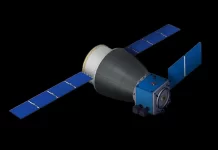

Space transportation startup The Exploration Company has announced the successful first test firing of its Breeze thruster, which will be used aboard its Nyx Moon lunar lander.
Founded in 2021, The Exploration Company is developing a modular, reusable spacecraft initially designed to transport cargo to and from the International Space Station. Future versions of the spacecraft will extend its reach to lunar orbit with Nyx Cislunar and the lunar surface with Nyx Moon.
On 17 July, the company announced the successful test firing of its Breeze thruster, which will be equipped on the Nyx Moon service module. The thruster’s name follows the company’s tradition of naming its rocket engines after increasingly powerful weather phenomena. Current engine names, in order of increasing power, include Breeze, Mistral, Huracán, and Typhoon, the latter being the company’s high-thrust, full-flow stage combustion rocket engine.
Breeze is a GOX/GCH4-powered thruster, the development of which, according to the company’s 17 July update, has progressed from initial concept to a completed test firing in just six months. The first successful test firing of the thruster lasted 47 seconds and was conducted at the company’s testing facility in Bordeaux. The next iteration of the Breeze thruster is currently in the design process, with testing expected to take place later this year.
In parallel with the development of its Breeze thruster, the company is in the middle of its post-flight Mission Possible investigation. The mission was a sub-scale test flight launched aboard a SpaceX rideshare mission on 23 June, aimed at validating the company’s re-entry technology. While the company successfully reestablished contact with the spacecraft after it reentered Earth’s atmosphere following the expected communications blackout, contact was lost at an altitude of 26 kilometres, just before the transonic phase that would have preceded the opening of its parachutes. The company intends to launch a follow-on to Mission Possible before moving onto the full-scale Nyx demonstration.
Keep European Spaceflight Independent
Your donation will help European Spaceflight to continue digging into the stories others miss. Every euro keeps our reporting alive.