Thales Alenia Space has awarded a contract to US-based Astrobotic to develop the wheels for the Multi-Purpose Habitation module, a mobile lunar habitat under development for the Italian Space Agency (ASI).
In 2020, ASI and NASA signed a joint statement of intent to cooperate on the development of a lunar habitat that could support crewed missions to the surface of the Moon as part of the Artemis programme. In June 2022, the pair signed a bilateral cooperation agreement under which ASI would conduct the preliminary design of the Multi-Purpose Habitation module. On 25 July 2025, ASI announced that it had awarded Thales Alenia Space Italia a contract to complete the module’s preliminary design phase, which includes the development of critical enabling technologies.
On 3 March, Thales Alenia Space awarded a contract to Astrobotic to develop wheels for the Multi-Purpose Habitation module.
Initial designs of the module did not include a mobility element, with the first indication that wheels had been added coming in July 2024, following the completion of the project’s mission definition review. In an interview with Fondazione Leonardo in August 2024, Nicola Genco, the project’s programme manager at Thales Alenia Space, explained that the wheels were added to allow the module to move to locations ideally suited to surviving the lunar night. However, he added that teams were exploring the possibility of using the system to move the module to different points of interest to support crewed Artemis missions to the lunar surface.
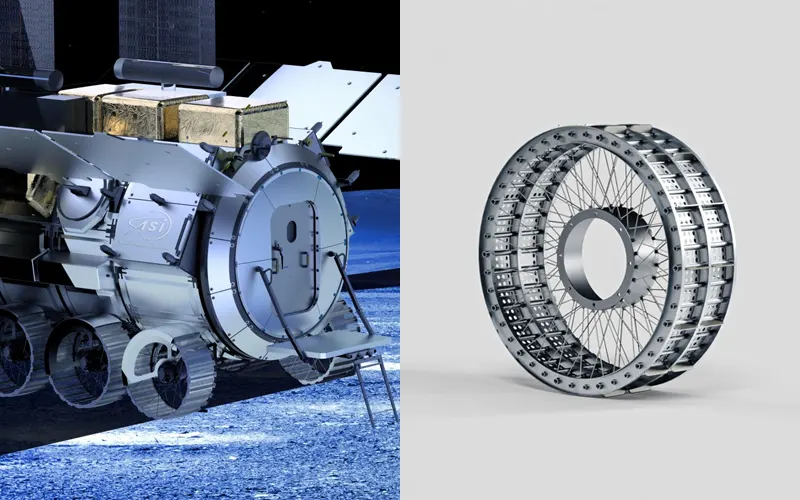
According to Astrobotic, the wheel it is developing for the Multi-Purpose Habitation module will be based on those developed for its Astrobotic Mobility Platform rover, scaled to accommodate the size, loading, reliability, and service life requirements of the module. It uses lightweight tensioned cables that connect the central hub to the outer rim, maintaining strength while reducing overall mass. The outer rim features flexible tread elements that allow the wheel to conform to the lunar surface, improving traction while reducing wear over time.
In total, the preliminary design phase of the project is expected to last approximately two years, at which point a decision on its future will be made. If the Multi-Purpose Habitation project is ultimately built, it will be three metres wide and six metres long and will have an operational lifespan of around ten years. It is designed to accommodate two astronauts for a mission lasting between seven and 30 days once a year. It will also be capable of supporting larger crews for shorter durations in emergency situations.
Keep European Spaceflight Independent
Your donation will help European Spaceflight to continue digging into the stories others miss. Every euro keeps our reporting alive.