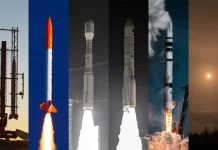

The UK Civil Aviation Authority has granted Skyrora a launch licence to conduct flights of its suborbital Skylark L rocket from SaxaVord Spaceport in Scotland.
Standing 11 metres tall, the Skylark L is a single-stage rocket capable of carrying payloads of up to 50 kilograms to an altitude of 102 kilometres. It was designed both as a platform for microgravity research and to validate core subsystems that will be used in Skyrora’s larger orbital-class rocket, Skyrora XL. Skyrora conducted an initial flight of its Skylark L rocket from Iceland in 2022. The flight ultimately ended in failure, with an anomaly occurring shortly after liftoff.
On 5 August, the company announced that it had received a launch licence allowing up to 16 suborbital Skylark L rocket launches per year from SaxaVord. According to a Civil Aviation Authority update, the licence granted to Skyrora comes with a number of conditions. Before each launch, the company will be required to secure adequate insurance, enter into a data-sharing agreement with the UK Government, and obtain airspace agreements with other countries.
While the company’s 5 August press release did not include an expected date for the next Skylark launch, Skyrora founder and CEO Volodymyr Levykin told European Spaceflight that it was unlikely to occur this year.
“Skyrora’s priority is to launch from the UK and deliver sovereign launch capabilities,” said Levykin. “Despite having a vehicle ready and a launch licence, it is unlikely that Skyrora will be able to complete its launch from the UK this year.”
What does this mean for the UK launch industry?
Rob Bishton, CEO of the UK Civil Aviation Authority, described the issuance of Skyrora’s launch licence as a “major milestone” for the country. The UK’s Aviation and Space Minister, Mike Kane, echoed this sentiment, calling it an “important milestone” for the UK space sector. Dr. Paul Bate, CEO of the UK Space Agency, went further, stating that with companies like Skyrora, the UK was positioning itself as “the natural choice for customers seeking reliable, cost-effective access to space.”
Currently, the roughly ten suborbital microgravity research missions conducted by Europe each year are launched from Andoya Spaceport and Esrange Space Center. These flights traditionally utilise small solid-fuel rockets, typically the Improved Malemute, Improved Orion, Black Brant, VSB-30, and, more recently, the newly introduced Red Kite boosters. In addition to these established launch platforms, T-minus from the Netherlands offers flights aboard its Dart and Barracuda rockets. Poland’s Łukasiewicz Institute of Aviation and SpaceForest are both in the final stages of developing suborbital rockets, with the latter expecting to launch the next test flight of its PERUN rocket before the end of the year. Then, there are the PLD Space MIURA 1 and HyImpulse SR75, both of which have completed successful inaugural test flights.
The Swedish Space Corporation, the company that manages the Esrange Space Centre, offers flights aboard its SubOrbital Express service for approximately €7,000 per kilogram. The service typically utilizes the Brazilian VSB-30 rocket, which offers a payload capacity of 400 kilograms, eight times that of the Skylark L. This would give a total cost per flight of around €2.8 million. While Skyrora has not disclosed the expected cost of its suborbital offering, its significantly smaller payload capacity means that competing on a per-kilogram cost with a VSB-30-like competitor will be challenging. Additionally, the VSB-30’s maximum altitude is more than double that of the Skylark L, providing more time in microgravity for the onboard payload.
To put it plainly, the market is small and the competitors are numerous. The Skylark L may well be used to launch microgravity research missions for UK governmental and institutional customers. In a commercial capacity, however, it faces a wide range of competitors and may struggle to compete on price with simpler solid-fuel alternatives. So, while the Skyrora Skylark L launch licence is an exciting milestone, some of the rhetoric may be overstating its overall importance to the fledgling UK launch industry.
Keep European Spaceflight Independent
Your donation will help European Spaceflight to continue digging into the stories others miss. Every euro keeps our reporting alive.