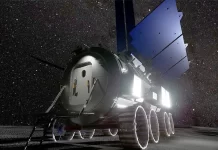

Italy’s Lunar Adaptive Outpost for Remote Italian Research (LAORIE) lunar lander mission has reached a key milestone with the completion of its Preliminary Requirement Review, marking the end of Phase A development.
“The LAORIE lunar lander mission is a joint initiative of Italy’s National Space Agency (ASI), National Institute for Astrophysics (INAF), and National Research Council (CNR), with INAF serving as the mission’s principal investigator. The mission forms part of INAF’s broader Earth-Moon-Mars (EMM) programme, funded through Italy’s National Recovery and Resilience Plan (PNRR), a national investment scheme created to boost economic growth after the COVID-19 pandemic. The EMM programme aims to enable the observation and study of Earth and the wider Universe from the “privileged perspective that only the Moon can provide.”
On 22 September, ASI announced that the project’s Preliminary Requirement Review was successfully completed on 16 July. This milestone formally concludes Phase A development of the mission, which was led by the prime contractor Thales Alenia Space Italia.
Phase A work focused primarily on the preliminary definition of requirements, which included establishing the mission’s key technical objectives, performance targets, and operational constraints for both the space segment (the lander itself) and the ground segment. Work on the ground segment of the mission included contributions from the Turin-based aerospace logistics technology company ALTEC.
According to ASI, the primary technological challenges faced during Phase A development focused on ensuring payload functionality throughout the entire mission. The agency also revealed that the mission is expected to last three years, one year longer than initially estimated.
The LAORIE lunar lander will carry three payloads: the Lunar Electromagnetic Monitor in X-rays (LEM-X) for all-sky monitoring in the X-ray band, the LUNAr Optical Polarimetry surveyor (LUNAPOL) to map interstellar polarization across wide areas of the sky, and the Lunar Earth Temperature Observatory (LETO) to continuously monitor the brightness temperature of Earth’s disk.
While the 22 September ASI update confirmed the conclusion of Phase A, it provided no indication of when, or even whether, the agency intends to continue developing the lunar lander mission.
Keep European Spaceflight Independent
Your donation will help European Spaceflight to continue digging into the stories others miss. Every euro keeps our reporting alive.