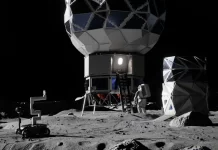

Luxembourg-based ispace-Europe has completed the Mission Definition Review for the European Space Agency’s MAGPIE lunar rover mission.
The Mission for Advanced Geophysics and Polar Ice Exploration (MAGPIE) is designed to prospect for water ice in the Moon’s south polar region. It will also map the distribution of hydrogen and study the geological history of the area. According to ispace-Europe, MAGPIE is currently slated for launch in 2028, although this timeline remains dependent on the approval of further funding.
In December 2024, an ispace-Europe-led consortium was awarded an initial pre-Phase A contract to begin the development of the MAGPIE mission. In June 2025, the consortium received an extension of its pre-Phase A contract, bringing its total value to €2.695 million.
On 10 September, ispace-Europe announced the completion of the Mission Definition Review (MDR) for MAGPIE, during which ESA experts evaluated the rover’s technical design, payloads, mission operations concept, surface science objectives, development schedule, and costs. With no critical or blocking issues identified, the review officially concluded the mission’s pre-Phase A development.
“The MAGPIE mission concept enables Europe to further build its strong leadership and expertise as part of an international lunar prospecting campaign for understanding how to access and responsibly utilise planetary resources,” said Francesca McDonald, a Moon Exploration Scientist at ESA. “MAGPIE importantly conducts investigations in situ at the surface at the local scale that robots and humans will work at.”
The next phase of the mission’s development will focus on advancing payload designs, building prototypes, and refining the interfaces between the rover and its instruments. Before work on this next phase can begin, ESA Member States will need to approve programmatic funding for the mission at the ESA Ministerial Council Meeting in November.
Keep European Spaceflight Independent
Your donation will help European Spaceflight to continue digging into the stories others miss. Every euro keeps our reporting alive.