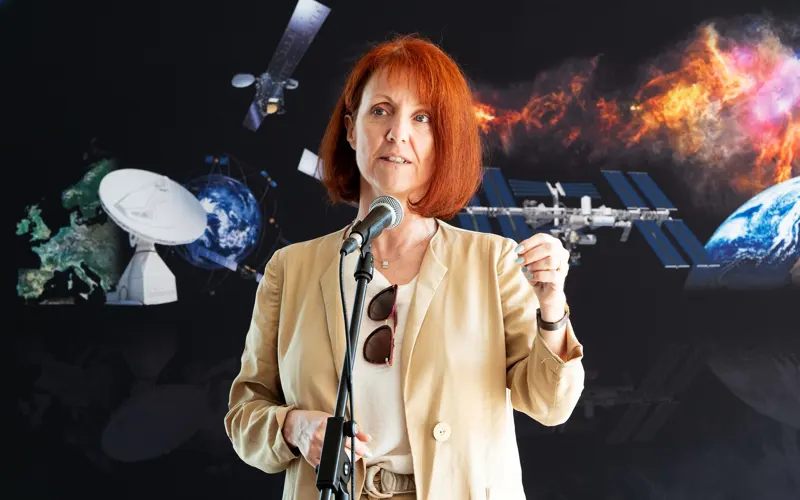
The European Space Agency’s Director of Science, Carole Mundell, has explained that Europe has the technical capabilities to replace NASA contributions to its science missions should the White House go ahead with budget cuts.
In May, the White House released a budget request for NASA for the 2026 fiscal year that includes a 25% cut overall, with the agency’s science program facing a 47% reduction. If approved, the net result of the new budget is that funding will be hard to come by, and contributions to international partners will likely be on the chopping block.
Since the announcement, ESA has been working with its Member States to identify which missions are likely to be affected and how best to mitigate the disruption. Speaking during a question-and-answer session following the agency’s 334th Council Meeting, Director of Science Carole Mundell offered an initial glimpse into how ESA’s upcoming science missions could be impacted.
According to Mundell, the agency is currently pursuing a total of 19 science missions that include contributions from NASA. She explained that for 16 of those missions, “good planning” would allow the agency to mitigate any impact. However, she added that for three missions, LISA, EnVision, and NewAthena, “recovery actions” would be required. This report only includes missions under the agency’s Science Directorate, with other missions across other directorates, such as the Rosalind Franklin rover under the Human and Robotic Exploration Directorate, also being impacted. In relation to the impact on ESA’s science missions, Mundell explained that NASA’s contributions to these programmes were not irreplaceable.
“We value deeply the collaboration between Europe and NASA, but we do have the technical capabilities in Europe today, should it be necessary to reproduce missing elements,” explained Mundell.
ESA Director General Josef Aschbacher echoed this sentiment during his visit to the Canadian Space Agency earlier this month, stating, “Europe and the European Space Agency will get out of this stronger, more autonomous, and more independent.”
Responding to questions following the 334th Council Meeting, Aschbacher explained that the new NASA budget is likely to be approved about a week before ESA’s Ministerial Level Council meeting later this year. As a result, the agency will likely need to prepare several contingency options for Member States to consider, depending on the outcome of the NASA budget vote.
Keep European Spaceflight Independent
Your donation will help European Spaceflight to continue digging into the stories others miss. Every euro keeps our reporting alive.