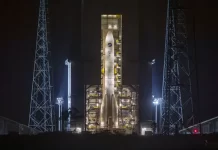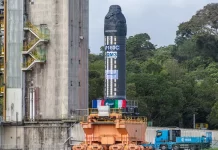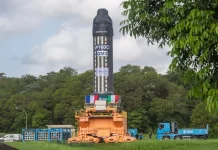

European launch services provider Arianespace has successfully launched the Sentinel-1D Earth observation satellite aboard an Ariane 62 rocket for the European Commission.
Launched in its two-booster configuration, the Ariane 6 rocket lifted off from the Guiana Space Centre at 22:03 CET on Tuesday. Approximately 34 minutes after liftoff, the satellite was deployed from the rocket’s upper stage into a Sun-synchronous orbit at an altitude of 693 kilometres. The rocket’s upper-stage Vinci engine is expected to perform a second ignition roughly two hours after liftoff to begin its deorbit manoeuvre.
The 2,184-kilogram Sentinel-1D satellite is a twin of Sentinel-1C, which was launched aboard a Vega C rocket in December 2024. Given that the Ariane 62 can deliver more than 10 tonnes to low Earth orbit, launching the 2.3-tonne Sentinel-1D on a dedicated flight appears excessive, particularly as its twin was launched on a Vega C rocket. The reason for this particular launch vehicle selection was one of expedience rather than suitability.
“We have faced practically a two-year stop in European launching and were really under pressure to launch these satellites,” said Mauro Facchini, Head of the Copernicus Unit for the European Commission. “Sentinel-1B was not working anymore, and Sentinel-1A is degrading in terms of its capacity. So we really needed to find the best European vehicles to launch these satellites as soon as possible. And the best candidates have been Vega C in December last year and Ariane 6 for this launch. Indeed, we are trying to launch as much as possible with European vehicles.”
Once Sentinel-1D is fully commissioned, it will replace Sentinel-1A, which has remained operational for four years beyond its expected seven-year lifespan. Sentinel-1A will be decommissioned and begin a several-year deorbiting process.
The Sentinel-1 satellites are part of Europe’s Copernicus Earth observation programme. They primarily carry a C-band synthetic-aperture radar that enables all-weather, day-and-night monitoring of land and sea. The Sentinel-1C and 1D satellites are also equipped with integrated Automatic Identification Systems (AIS) for maritime traffic monitoring and GNSS receivers compatible with Galileo, the European Union’s independent global navigation satellite system.
Keep European Spaceflight Independent
Your donation will help European Spaceflight to continue digging into the stories others miss. Every euro keeps our reporting alive.