
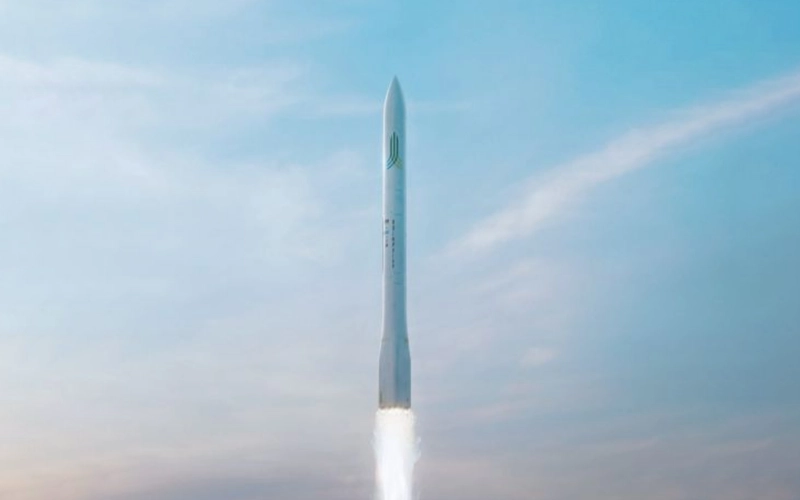
German launch services provider HyImpulse announced on 2 September that it had extended its Series A funding round by more than €50 million, bringing its total funding to date to €125 million. The company is currently preparing for the second flight of its suborbital SR75 rocket and the inaugural launch attempt of its larger SL1 rocket.
The company announced its initial €15 million Series A raise in October 2025. With this latest raise, HyImpulse has now secured more than €65 million in Series A equity funding. The extension was co-led by German early-stage venture capital firm JOIN Capital and Israeli aerospace and defence investor Ace Capital Partners, neither of which participated in the initial Series A raise.
The new funding will be used to “accelerate development and commercialization of HyImpulse’s launch services portfolio.”
“With this injection of capital, we will accelerate the commercialization of our orbital rocket, making Europe more independent and competitive,” said HyImpulse CEO Christian Schmierer. “While providers such as SpaceX offer a scheduled bus service to space, our solutions allow us to develop a flexible taxi service so that our customers can choose individual launch solutions and flexibly plan their schedules.”
According to the company, it is positioning itself to meet a “growing demand for independent launch capabilities” and has already secured an order book exceeding €350 million across its suborbital and orbital programmes.
Preparing for launch
To date, the company has launched a single flight of its suborbital SR75 rocket. This inaugural flight was conducted from the Koonibba Test Range in South Australia in May 2024. More than two years later, the company is preparing for the rocket’s second flight, which will take place from SaxaVord Spaceport in Scotland before the end of 2026.
While its 2 September 2026 announcement did not detail the nature of the flight, HyImpulse said in October 2025 that the mission would be SR75’s first commercial launch to carry customers.
At the same time, the company is also preparing for the inaugural flight of its three-stage SL1 rocket, which is designed to carry payloads of up to 600 kilograms to low Earth orbit. While the company has previously stated that the flight would occur in 2027, its latest announcement did not provide a target date for the mission, saying only that the new funding would help accelerate preparations for the flight.

“With this injection of capital, we will accelerate the commercialization of our orbital rocket, making Europe more independent and competitive” – Someone has yet to show that hybrids can be optimized to provide performance sufficient to reach orbit. My working theory is that also HyImpulse does not know if they can make that work. Vague statements about launch date of SL1 and the use of the latest funding seem to confirm that.
Hybrids have a firm place in areas where performance is secondary to safety like research, education and possibly suborbital human transport (SpaceShipOne). Impulse is chronically low and complexity and dry mass higher than solids.