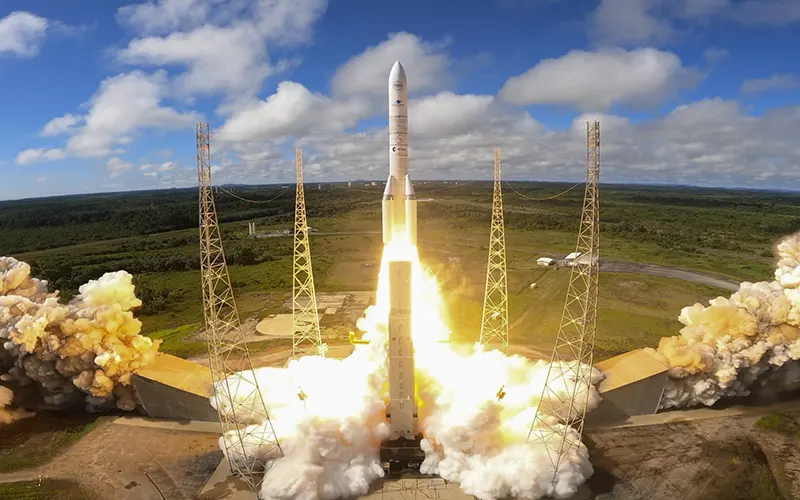
The European Space Agency has awarded a contract to launch its solar storm-monitoring CubeSat on an Ariane 6 rocket.
Scheduled for launch in early 2027, the Henon CubeSat will be flown as a secondary passenger alongside ESA’s PLATO telescope, which will be tasked with finding Earth-like exoplanets. According to the agency’s 16 July press release, a feasibility study was first conducted with Arianespace to confirm that CubeSats could be safely accommodated as secondary payloads aboard an Ariane 6 flight.
“Henon was a reference case, but we also looked at how many CubeSats could be accommodated in this launch architecture,” said Roger Walker, Head of CubeSat missions at ESA. “We can fit up to four 16U CubeSats, in fact.”
While the feasibility study was conducted with Arianespace, the press release did not confirm whether the launch contract was awarded directly to the commercial operator of Ariane 6 or to a launch aggregator. Speaking to European Spaceflight, an ESA spokesperson explained that “the work order for the launch service was signed between [the] Henon [consortium] and Arianespace in the second half of June.” ESA awarded Arianespace the contract for the launch of PLATO, the mission’s primary passenger, in January 2025.
According to ESA, once launched, the Henon probe, which is being built by Italy’s Argotec, will become the “first CubeSat ever to independently venture into deep space, communicate directly with Earth and manoeuvre to its final destination without relying on a larger ‘parent’ spacecraft.” This claim is debatable, though.
NASA’s MarCO CubeSats, a pair of briefcase-sized spacecraft nicknamed “Wall-E” and “Eve”, arguably ticked all three of those boxes back in 2018. While launched alongside the InSight Mars lander, the CubeSats were deployed separately from the rocket’s upper stage and cruised to Mars independently, performing trajectory correction manoeuvres with cold-gas thrusters. The two CubeSats also communicated directly with Earth and relayed InSight’s landing telemetry in real time.
Even if Henon’s claim to a first is contested, the mission will be more complex than those that came before it. The MarCO twins performed a ballistic flyby of Mars with only minor course corrections. Henon will use its miniaturised electric propulsion system to manoeuvre into a distant retrograde orbit around the Sun, a far more demanding task. Once in its operational orbit, Henon will monitor solar activity to demonstrate an early-warning capability for solar storms.
Update: This article was updated on 18 July to include clarification from an ESA spokesperson on when the launch contract was awarded and which company received it.