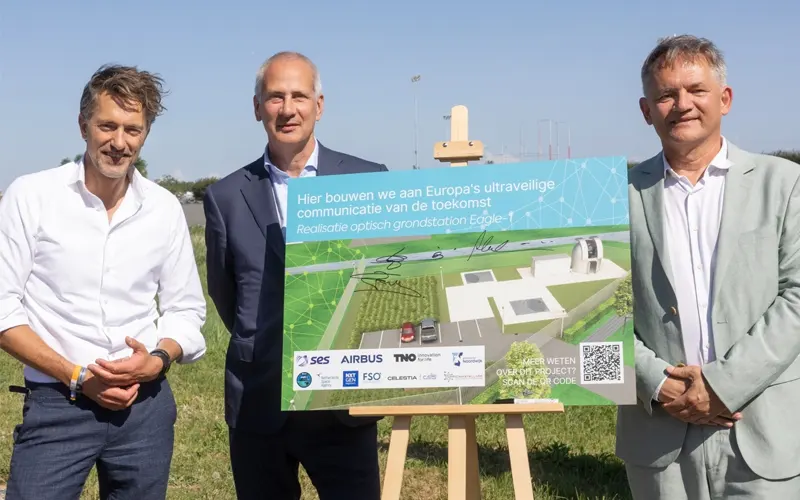
European satellite operator SES and Airbus have secured a site at the NL Space Campus in Noordwijk for the Eagle-1 optical ground station. The announcement comes less than two months after the launch of the system’s satellite component was once again delayed, this time until no earlier than late 2027.
SES and Airbus Netherlands signed a ground lease agreement with the Dutch municipality of Noordwijk on 15 June, securing a site near ESA’s ESTEC facility for the construction of the Eagle-1 ground station. The station will include a control room and a dome housing an optical telescope that will track the Eagle-1 satellite to maintain the precise laser link the system requires.
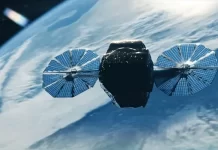
The EAGLE-1 system is being built to demonstrate quantum key distribution (QKD) between optical ground stations over distances that are impractical to achieve via fibre. Only the key exchange uses the quantum channel, while the communications it secures travel over conventional networks. The system will act as a precursor to the European Quantum Communication Infrastructure, which will form part of the continent’s IRIS2 secure communications network.
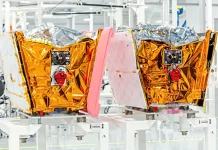
An SES-led consortium was awarded the contract to build the EAGLE-1 demonstration system in September 2022. The satellite’s construction is being led by SITAEL, with Germany’s TESAT Spacecom providing the QKD payload. SES awarded TNO and Airbus Netherlands the contract to build the system’s optical ground station in November 2023.
The launch of the Eagle-1 space segment has been delayed several times. In November 2022, just two months after the initial development contract was awarded, SES selected Arianespace to launch the satellite aboard a Vega C rocket, with the flight expected to be “as early as Q4 2024.” Announcing the most recent delay during the EU Space Days conference in late May, SES Techcom managing director Alan Kurešević said that the payload’s technology was still posing challenges. He explained that the launch was now expected at the end of 2027 or early 2028.
When ESA initially awarded SES the contract to develop the EAGLE-1 system, ESA’s then-director of telecommunications, Elodie Viau, said the programme, including the satellite and ground systems, would cost approximately €130 million. At the time, the satellite was expected to launch in 2024. With the launch now delayed by around three years, it is unclear whether the programme’s budget has increased and, if so, who will cover the additional costs.