
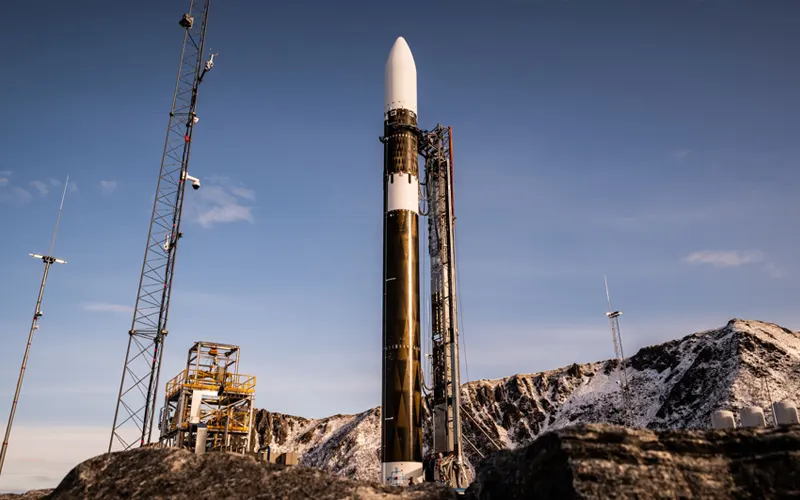
Isar Aerospace announced a partnership with German maritime defence company TKMS to establish a sovereign Canadian launch capability. According to TKMS, the partnership is an “integral contribution” to its bid to supply Canada with 12 new submarines.
In 2021, Canada initiated its Canadian Patrol Submarine Project (CPSP), with the goal of acquiring up to 12 conventionally powered submarines to “detect, track, deter and, if necessary, defeat adversaries in all 3 of Canada’s oceans.” In August 2025, Canada selected TKMS and South Korea’s Hanwha Ocean as the two qualified suppliers for the project. Final bids were reportedly submitted in early March 2026, with a decision expected later this year.
TKMS’s bid for the CPSP contract would see it supply Canada with its Type 212CD submarines. With its most recent announcement, the company is seeking to emulate its competitor, Hanwha, by supplementing its bid with commitments to other key Canadian priorities alongside the submarine deal.
On 19 May, TKMS announced that, as an integral element of its CPSP bid, it had partnered with German launch services provider Isar Aerospace to help establish sovereign Canadian access to space. This commitment would include a “significant investment in building a Canadian Space launch complex.” This is an area that the country has identified as strategically important for its defence needs.
“To have a fully interconnected system, from Yellowknife to Trenton, from ships at sea to fighter jets in the air, Canada needs its own space capability,” said the country’s Defence Minister David McGuinty in March 2026. “It is not just satellites that are critical; it is access to space itself.”
As part of the agreement, Isar Aerospace will establish a local Canadian entity and partner with small and medium-sized local businesses to build out a sovereign Canadian satellite launch capability. While the announcement does not specifically identify the launch facility the pair will be investing in, it does reference high-skilled jobs being created in Nova Scotia, where a facility is being developed by Canadian launch infrastructure startup Maritime Launch Services.
This effort to broaden its economic impact in Canada, aimed at making its CPSP bid more attractive, appears to mirror a similar strategy being employed by Hanwha.
In January 2026, Hanwha announced a series of memoranda of understanding with Canadian companies that span a wide range of industries, including steel, artificial intelligence, and space. On the space side, the company has signed an agreement with MDA Space to explore collaboration on the development of secure low Earth orbit communications, an area that the country has also identified as strategically important.
The question is, why has TKMS partnered with a German launch provider instead of one of the emerging Canadian providers?
In March, Defence Minister McGuinty announced a string of investments to support the country’s ambitions of developing a sovereign launch capability, including $200 million for Maritime Launch Services. The announcement included three Phase 1 awards for the country’s Launch the North initiative, which initially aims to invest $105 million over three years to establish a sovereign light-launch capability by the end of 2028. The initial awards included $8.3 million for Reaction Dynamics, the Canada Rocket Company, and NordSpace.
Isar Aerospace’s involvement in developing a sovereign launch capability may, as a result, be focused on supporting these homegrown companies rather than launching its Spectrum rockets from Nova Scotia. In a comment included in the TKMS announcement, Isar Aerospace Chief Commercial Officer Stella Guillen explained that the company “stands ready to provide the technology, the scale, and the industrial resolve,” a statement that, while vague, supports an interpretation of Isar’s role as an industrial and technical enabler rather than necessarily as the operator of a future Canadian launch capability.
When asked for clarification on its role, an Isar Aerospace spokesperson told European Spaceflight that it could not share any additional information beyond what had been released in the 19 May press release.