
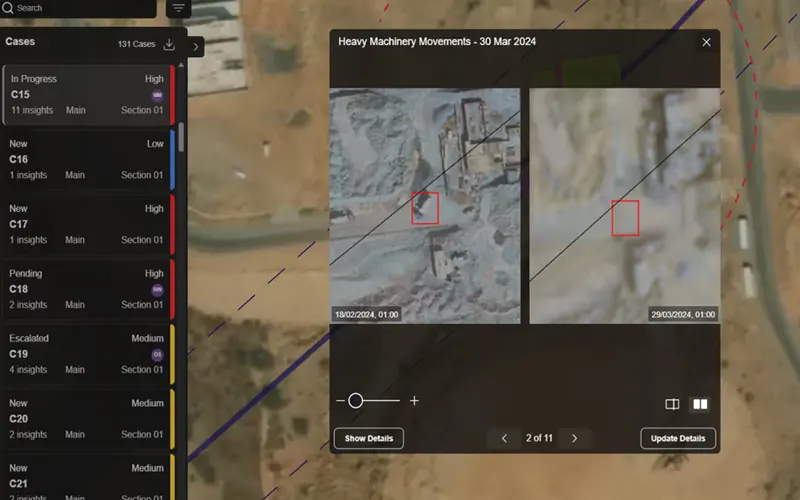
German Earth observation data provider LiveEO has closed a €28 million funding round. The company plans to use the funding to accelerate its expansion into dual-use defence and security services, as it positions itself to compete for a share of Germany’s planned €35 billion in spending on space-related defence projects.
Founded in 2018, the Berlin-based company currently offers “AI-powered” Earth observation analytics for use cases including critical infrastructure monitoring, vegetation management, supply chain visibility, and environmental risk monitoring. Its services use data sourced from commercial satellite operators and public missions. However, earlier this year, LiveEO announced plans to launch its own satellite constellation, a project for which it has secured seven-figure funding from the European Space Agency’s InCubed programme.
On 6 May, the company announced a new €28 million funding round that was largely supported by existing investors, with German venture capital firm Helantic the only new investor added. According to the company, the new funding will be used to expand its current offering and accelerate plans to develop new products for defence and security customers.
“The civil infrastructure world requires smarter, continuous risk intelligence as climate pressure mounts, and the defense world is waking up to the fact that the same geospatial capabilities are essential for security and sovereignty,” explained LiveEO co-CEO Sven Przywarra.
In its justification for pursuing the development of defence and security solutions, the company directly referenced Germany’s planned €35 billion in spending on space-related defence projects. The country announced the spending commitment in September 2025, specifically identifying the need for space-based reconnaissance.
The first contract awarded under this new spending plan gives a sense of the potential upside. In November 2025, an ICEYE-Rheinmetall joint venture secured a €1.7 billion deal to provide Earth observation data to the country’s armed forces from late 2025 to the end of 2030.