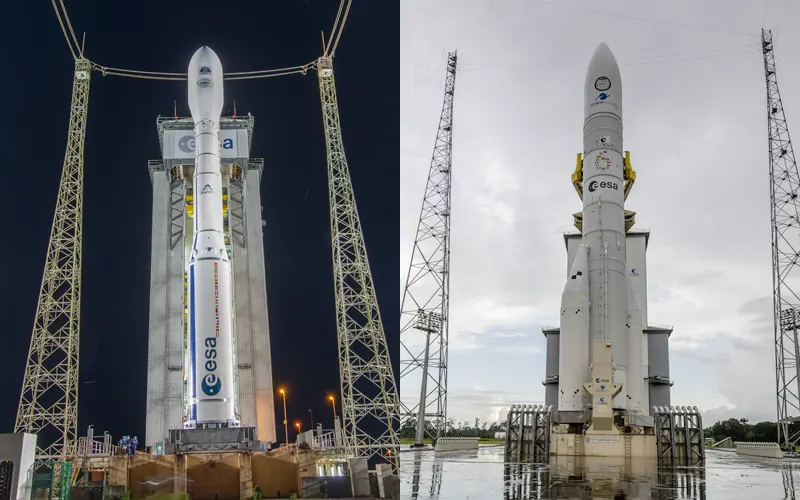
The European Space Agency has published a Request for Information (RFI) that suggests it is considering shifting the launch of its Harmony satellites from Vega C to Ariane 6.
In October 2024, ESA awarded OHB a €280 million contract to develop and build a pair of satellites for its Harmony mission, which will monitor shifts in the shape of Earth’s land surface caused by earthquakes and volcanic activity. While neither ESA nor OHB identified a proposed launch vehicle at the time, a Thales Alenia Space release from the same day announcing its subcontract for the mission’s Synthetic Aperture Radar instruments identified Vega C as the planned launch vehicle.
More recently, ESA confirmed Vega C as the mission’s baseline launch vehicle during a presentation given by Project Manager Florence Hélière at the agency’s Living Planet Symposium in June 2025. Hélière explained that both satellites would be launched in 2029 aboard a single Vega C Block 2, which features the P160C booster upgrade. She also indicated that cost constraints had helped shape the decision to select a single Vega C launch for both satellites.
On 22 April, ESA published an RFI inviting Arianespace to provide “non-binding information on Ariane 62 launch services for the Harmony mission in Q4 2029 / Q1 2030.” The RFI asks for options for both a dedicated launch and a shared mission that would carry the Harmony satellites to orbit alongside additional payloads. In addition to raising questions about the apparent schedule slip from 2029 to potentially early 2030, the RFI may also point to concerns within ESA about whether Vega C Block 2 will be available in time to support the launch.
The primary upgrade in the Vega C Block 2 variant is the replacement of the current P120C solid-fuel booster with the P160C, increasing the payload capacity of not only Vega C but also Ariane 6, which is equipped with two or four of the same solid-fuel boosters mounted around its core stage.
In January 2026, an ESA spokesperson told European Spaceflight that there was no urgency to complete the P160C upgrade for Vega C, with the first flight with the new booster not expected until 2028, carrying the first flight of the agency’s reusable Space Rider spacecraft. The upgrade is expected to be used first aboard an Ariane 64, the rocket’s four-booster variant, later this year. The reasoning given by ESA for the delay was that the mission planned aboard Vega C would not require additional performance and would allow the initial P160C manufacturing capacity to be dedicated to Ariane 6 missions.
Arianespace is currently working through its backlog of Ariane 6 missions, which includes a block of 18 flights to deploy satellites for Amazon’s LEO megaconstellation. While the first two flights were completed aboard P120C-equipped Ariane 64 rockets, the remaining 16 will require the upgraded rocket variant. As part of its FCC authorization, Amazon is required to complete the deployment of its more than 3,200-satellite constellation, including those being launched aboard Ariane 6, by 30 July 2029.
In 2024, when Ariane 6 debuted, Arianespace managed just a single flight. In 2025, it ramped up its launch cadence, quickly completing four successful flights. In 2026, the company stated that it is targeting between six and eight Ariane 6 flights, with the latter nearing the rocket’s maximum annual capacity of ten flights.
Even if Arianespace achieves the ambitious doubling of its launch cadence from 2025 to 2026 and maintains that pace through 2027 and 2028, with much of its capacity going toward Amazon, the math suggests those flights could still bleed into 2029. This means that manufacturing capacity for the P160C booster, which has only just been certified fit for flight, is likely going to be tied up by Ariane 6. That manufacturing pressure has direct consequences for Vega C.
As one of the agency’s flagship projects, Space Rider will have earned a dedicated P160C-equipped Vega C flight. Harmony may offer more wiggle room in selecting a launch vehicle. And while Vega C requires its Block 2 upgrade to launch the two Harmony satellites, a two-booster Ariane 6 with the old P120C boosters would likely have capacity remaining to complete their deployment. This would offer the option of a rideshare mission, potentially reducing the total cost in line with a flight aboard Vega C. As a result, ESA’s interest in an Ariane 62 option may be twofold: it could ease pressure on Vega C Block 2 and P160C availability while preserving the cost logic of the original launch architecture by flying Harmony alongside a co-passenger.
Keep European Spaceflight Independent
Your donation will help European Spaceflight to continue digging into the stories others miss. Every euro keeps our reporting alive.