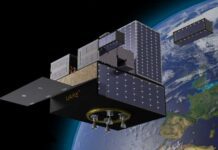
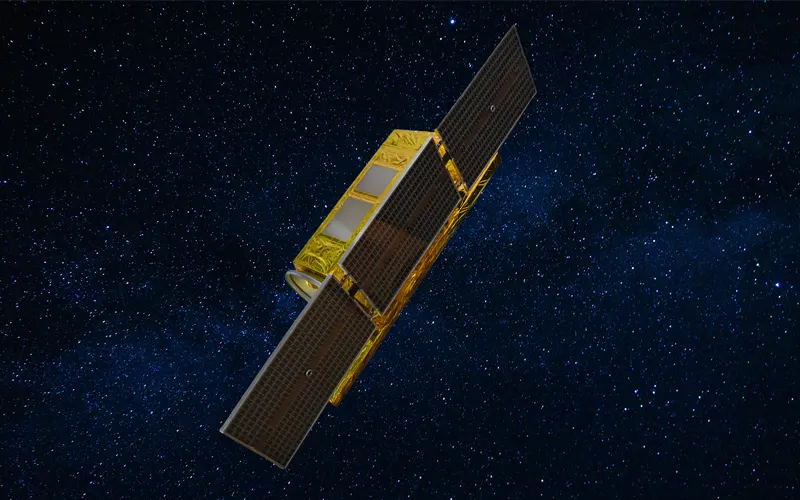
The European Defence Agency (EDA) has awarded a €15.65 million research contract to a consortium led by Spanish aerospace engineering company Sener to design a military satellite specifically optimised for very low Earth orbit (VLEO).
VLEO is the region of space between approximately 150 and 350 kilometres above the surface of Earth. Operating in this region of Earth’s orbit offers several benefits, including sharper imagery for Earth observation satellites and reduced latency for communication satellites. It does, however, come with drawbacks, as the effects of atmospheric drag at this altitude require constant reboosting to maintain a satellite’s altitude, reducing its overall operational lifespan.
On 13 March, the EDA announced that it had awarded the VLEO-DEF research contract to a consortium of 17 companies led by Spain’s Sener. The VLEO-DEF project is funded by five member states: Spain, France, Luxembourg, Portugal, and Slovenia, with consortium members from each country represented. The project is expected to run for 36 months.
The VLEO-DEF project follows earlier EDA research into very low Earth orbit satellites under the LEO2VLEO: Military Crisis-Response Satellite Constellation programme. The €10 million project began in January 2024 and is a collaboration between the Netherlands and Austria to design, develop, and launch a constellation of three satellites capable of manoeuvring from LEO to VLEO for short missions before returning to LEO.
The other sixteen companies that make up the VLEO-DEF consortium are DEIMOS, Airbus Defence and Space, and SATLANTIS from Spain, INEGI, GEOSAT, and OMNIDEA from Portugal, INTEGRASYS, SPARC, LIST, RAFINEX, EMTRONIX, GomSpace, and GRADEL from Luxembourg, Exotrail and Thales Alenia Space France from France, and Skylabs from Slovenia.