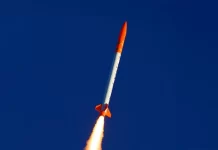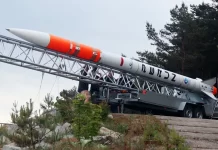

Suborbital launch services provider SpaceForest has announced that the third flight of its PERUN rocket will take place on 22 November. The flight will be the rocket’s first since 2023 and follows the completion of a redesign of the SF-1000 hybrid propulsion system that powers it.
PERUN is an 11.5-meter suborbital rocket designed to be capable of carrying payloads of up to 50 kilograms to an altitude of 150 kilometres. SpaceForest conducted two PERUN launches in 2023, both of which experienced anomalies that required mid-flight aborts. In October 2024, the company received €2.4 million in funding from the European Space Agency through its Boost! programme, which aims to foster the development of commercial European space transportation capabilities. The funding was awarded to upgrade the SF-1000 hybrid propulsion system, specifically its nozzle, and to conduct a series of four qualification flights.
On 19 November, SpaceForest announced that the first of these qualification flights would take place on 22 November from Poland’s Central Air Force Test Range in Ustka. While the company indicated a provisional liftoff time of 13:00 CET, it added that the exact time would be confirmed 40 minutes before the expected launch. If there are any issues with preparation or weather conditions, a backup opportunity is available on 24 November. With this initial test, SpaceForest is targeting a maximum altitude of 60 kilometres.
In addition to serving as a step toward the rocket’s qualification, the mission will also be the first PERUN flight to carry commercial payloads. The mission will be part of a Polish Space Agency initiative to utilise unused payload capacity aboard suborbital rocket test flights. Earlier this year, the agency awarded a PLN 1.95 million (€458,000) contract to a consortium led by the Łukasiewicz Research Network’s Institute of Aviation, with SpaceForest providing the rocket for the flight.
Following a successful flight, SpaceForest will look to complete the second of its four qualification flights before the end of the year, targeting an altitude of 80 kilometres. The company will then attempt its first space shot, aiming to reach an altitude of 100 kilometres, the recognised edge of space known as the Kármán line. It will then proceed with a test of the rocket’s full performance to an altitude of 150 kilometres. Both flights are expected in 2026. The first of the two flights is planned to take place on the island of Santa Maria in Portugal, and the second from a sea-based platform in the North Sea.
Keep European Spaceflight Independent
Your donation will help European Spaceflight to continue digging into the stories others miss. Every euro keeps our reporting alive.