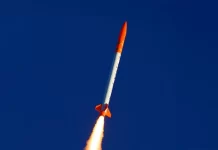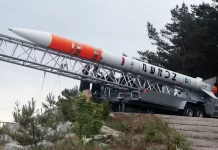

Polish rocket builder SpaceForest has completed the final hot fire test of its SF-1000 rocket engine. The company is now preparing for the next test flight of its 11.5-metre suborbital PERUN rocket, which will be powered by the newly qualified engine. The launch is expected before the end of 2025.
SpaceForest completed an initial hot fire test of its redesigned SF-1000 rocket engine at the end of 2024, followed by the first full-duration test in February 2025. However, the most recent test appeared to feature a component not present in the earlier campaigns, with the company deliberately obscuring the engine nozzle in the released video, something it had not done with footage from previous tests.
The hidden hardware appears to be related to the engine’s thrust vectoring capability, with this test being the first to clearly demonstrate such functionality. This aligns with a February 2025 SpaceForest update, which stated that the final SF-1000 engine test would be used to validate the Thrust Vector Control system.
In a section of the video where the engine’s nozzle was not fully blurred, it appears to feature a form of variable geometry similar to what is typically seen on the engines of fighter jets. However, this type of technology is not commonly used to control the thrust of a rocket engine, making its inclusion here particularly noteworthy. The February update also supports this, with the company explaining that the system incorporates an innovative carbon–carbon composite material capable of withstanding “extreme conditions.”
According to a 4 August update from SpaceForest, the novel Thrust Vector Control system will enable real-time trajectory corrections, a capability the company describes as “critical for launches from unconventional locations, including sea-based platforms.” In July 2025, the company signed an agreement with EuroSpaceport to launch a PERUN rocket from its North Sea facility in the second half of 2026. To establish this unique launch site, EuroSpaceport plans to convert a repurposed offshore wind turbine service vessel into a sea-based platform off the coast of Denmark.
Before the North Sea launch, SpaceForest will conduct a test mission from the Central Air Force Training Range in Ustka, Poland, in autumn 2025 (between September and November). This will mark the company’s third attempt to launch the rocket, with both previous launches in 2023 aborted mid-air as a result of in-flight anomalies. The company is expected to conduct a launch from the Portuguese island of Santa Maria in the first half of 2026, before proceeding with its sea-based launch attempt.