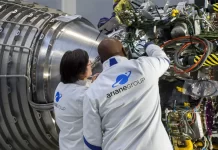

European rocket builder ArianeGroup has announced that it completed a series of Prometheus rocket engine test ignitions on 20 June, marking a key milestone in the programme.
Developed under a European Space Agency contract, Prometheus is a reusable rocket engine capable of producing around 100 tonnes of thrust. It is designed to be manufactured at a fraction of the cost of current European engines, with the use of additive manufacturing playing a key role in reducing production costs.
On 2 July, ArianeGroup announced that it had completed the successful Prometheus engine test, which included four successive ignitions in a single day. The tests were carried out on the Themis reusable stage demonstrator ground model, known as T1G, at the company’s Vernon site in France. According to an ArianeGroup press release, the multiple ignitions over a single day represent a “significant advancement in the engine’s development.”
Prometheus will initially power the T1H Themis demonstrator, which is set to lift off from the Esrange Space Centre in Sweden. The likely next firing of a Prometheus engine will occur during a static fire test of the fully integrated T1H demonstrator on its launch pad at Esrange. A low-altitude hop test of the demonstrator is then expected to follow before the end of the year.
While the engine will initially be used aboard the Themis demonstrator, its first commercial application will be the two-stage Maia rocket, developed by MaiaSpace, an ArianeGroup subsidiary. Maia will utilize four Prometheus engines, three for the first stage and one vacuum-optimised engine for the upper stage. An inaugural flight of the Maia rocket is expected in the second half of 2026.